
Chapters
- Introduction
- Technology and Market Overview
- The Policy, Regulatory and Standards Landscape
- Market Availability and Installation Data
Deep Dives

Company profile
Refra manufactures hydrocarbon-based chillers and heat pumps as well as transcritical CO₂ (R744) racks. The company was founded in 1994 and is headquartered in Vilnius, Lithuania.
For this Deep Dive ATMOsphere spoke with Evaldas Kimso, Chief Commercial Officer at Refra, about the company’s chillers and heat pumps.
Interview
Question 1 of 7
Can you briefly detail Refra’s natural refrigerant chiller and heat pump lineup?
Evaldas Kimso
Refra offers a comprehensive portfolio of heat pumps utilizing propane [R290] and isobutane [R600a] as well as chillers based on propane and propylene [R1270]. Notably, 100% of Refra’s chiller and heat pump solutions are designed to operate with natural refrigerants, reflecting the company’s full commitment to environmentally responsible technologies.
Question 2 of 7
What is currently driving demand for Refra’s natural refrigerant chillers and heat pumps in Europe and why?
EK
Refra’s natural refrigerant chillers and heat pumps are deployed across a broad spectrum of commercial and industrial applications, including manufacturing facilities, office buildings, educational institutions, HVAC systems, the automotive industry, district heating networks, processing plants and medical facilities.
Demand for these solutions has increased significantly over the past three to five years. Notably, 2022 marked a major inflection point, with sales of propane-based chillers and heat pumps increasing by approximately 40 to 50% compared to the previous year, a near doubling of volume. We’ve seen steady growth in subsequent years driven by rising demand for energy-efficient and sustainable solutions as well as evolving regulatory requirements.
Question 3 of 7
What are the top drivers for the adoption of natural refrigerant commercial chillers and heat pumps in Europe?
EK
The adoption of natural refrigerant systems has been influenced by several key factors. Even prior to formal regulatory changes, market demand was driven by the superior energy efficiency and sustainability profile of these systems as well as rising costs and volatility associated with traditional heating fuels.
Additionally, growing awareness of the environmental impact of synthetic refrigerants and alignment with broader initiatives such as the European Green Deal have played a significant role. Following the latest updates to f-gas regulations, regulatory compliance has become an increasingly decisive driver, further accelerating adoption.
Question 4 of 7
What are some of the barriers preventing the wider adoption of commercial natural refrigerant chillers and heat pumps, and how can these be overcome?
EK
Several challenges continue to influence the wider adoption of natural refrigerant systems. Safety concerns, particularly regarding the flammability of refrigerants such as propane and propylene, as well as the high operating pressures associated with CO₂ systems, have been the primary barriers. However, these concerns can be effectively mitigated through strict adherence to established safety standards, the integration of advanced safety mechanisms and a strong focus on manufacturing quality.
Another consideration is the higher initial investment compared to systems using synthetic refrigerants. While lifecycle cost benefits often offset this, upfront cost remains a factor in decision-making. Additionally, retrofitting existing infrastructure to accommodate natural refrigerant systems can present technical and logistical challenges. Addressing these barriers requires continued technological innovation, education and industry alignment on best practices.
Question 5 of 7
One trend we’ve noticed is a growing demand for larger chillers and heat pumps from 500kW up to and exceeding 1MW. What is Refra’s approach to meeting this demand: modularity or building larger individual units?
EK
Refra has long positioned itself as a highly flexible solutions provider with a core focus on delivering customized cooling and heating systems tailored to specific customer requirements. As such, high-capacity systems are a well-established area of expertise for the company.
In recent years, Refra has also introduced standardized product lines to reduce lead times and streamline procurement. These standardized units are designed with scalability in mind and can be modularized or configured in cascades to meet higher capacity demands. This hybrid approach, combining customization with modular standardization, enables Refra to efficiently address growing market needs in the 500kW [142TR] to 1MW+ [284TR+] range.
Question 6 of 7
What trend or new development related to natural refrigerant chillers and heat pumps in Europe is Refra watching closely?
EK
Refra is closely monitoring the growing demand for high-temperature heat pumps utilizing natural refrigerants, particularly in the context of district heating applications. The company places strong emphasis on delivering verified, real-world performance, ensuring that systems can reliably achieve and sustain required outlet temperatures over extended periods rather than relying solely on nominal or catalog values. As a result, significant investment is being directed toward the development of robust, high-performance solutions capable of delivering consistent and uninterrupted heating.
In parallel, Refra is actively following developments in data center cooling, recognizing it as a rapidly evolving segment with increasing relevance for natural refrigerant technologies. These trends are directly shaping the company’s product development roadmap and innovation priorities.
Question 7 of 7
What do you see as the next industry in Europe to be disrupted by natural refrigerant commercial chillers and heat pumps and why?
EK
The next major disruption will likely be commercial building heating retrofits, especially hotels, offices, healthcare facilities, schools, public buildings and mixed-use properties moving from gas boilers and HFC chillers to R290 heat pump/chiller platforms.
- Refra saw a spike in sales of its propane chillers and heat pumps the same year the European Commission shared its proposal to revise the EU F-gas Regulation. The proposal, shared in April of 2022, included the phase out of HFCs in new equipment by 2050 and a cap on EU HFC production.
- Safety concerns about the flammability of hydrocarbon refrigerants and the high operating pressures of CO₂ remain barriers to adoption. Higher initial investment costs for natural refrigerant-based systems, despite their lower lifetime cost, remain a challenge as well.
- Refra’s product roadmap is being shaped by two emerging applications for chillers and heat pumps, respectively: data center cooling and district heating.

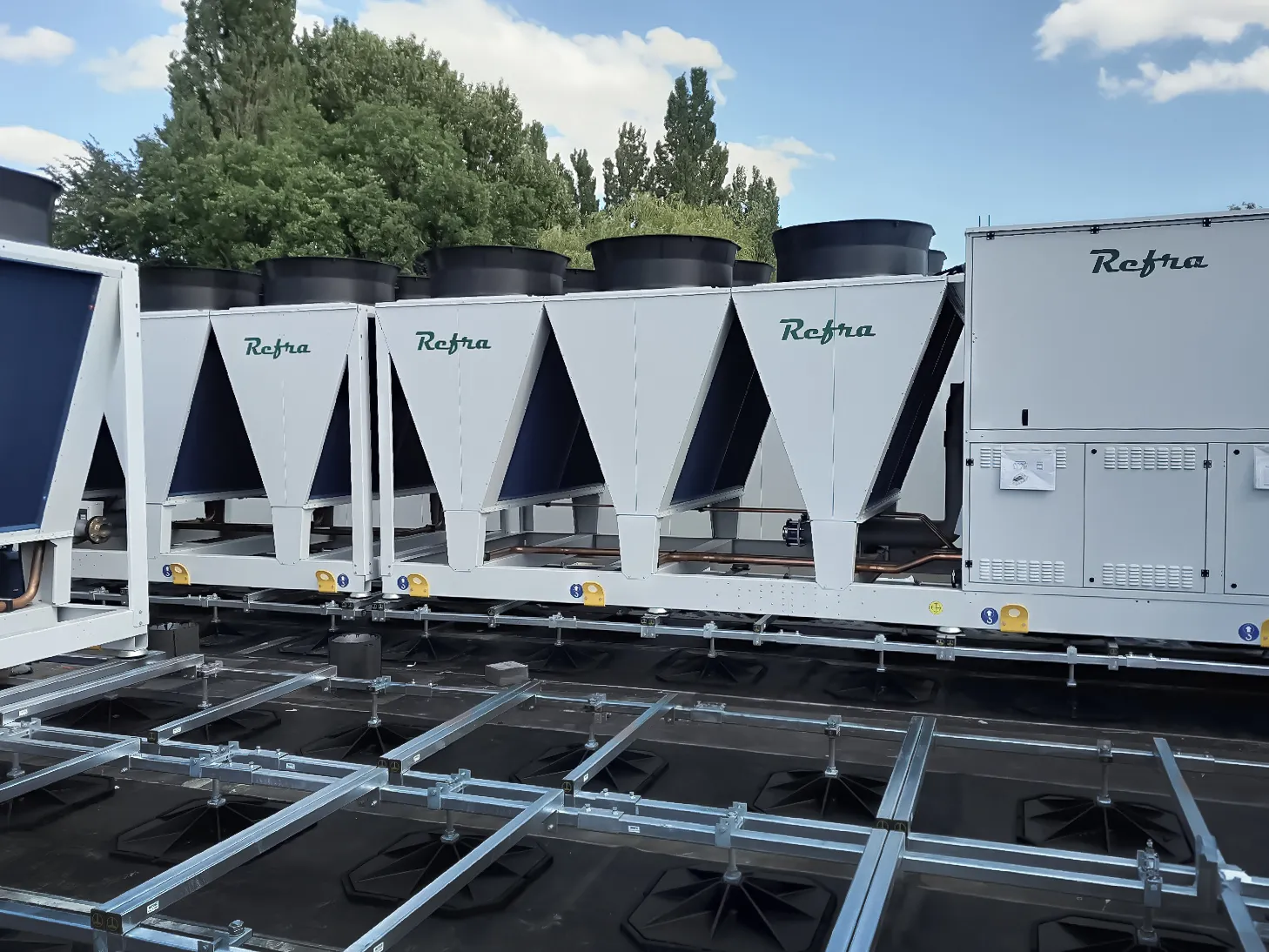
In 2025 six Refra hydrocarbon heat pumps totaling 1.6MW (454TR) of heating capacity were installed in the town of Solihull, England, to serve the town’s district heating network. Five of the heat pumps are air-source and use propane refrigerant, and one is a water-source unit using isobutane. The heat pumps are part of a new district energy network that provides heat for space heating and domestic hot water, as well as electricity, to buildings within the Solihull town center. Solihull has a population of 126,000 and is located southeast of Birmingham.
Powering the Commitment to Net-Zero
Solihull has committed to reaching net-zero emissions by 2041, and the new district energy network is designed to help meet that goal. The heat pumps get their energy from a gas-powered combined heat and power (CHP) system, with the excess electricity distributed to customers.
The five air-source propane heat pumps each have a heating capacity of 171.6kW (48.8TR) and a cooling capacity of 169.8kW (48.3TR). They have a COP of 4.64. The single water-source isobutane heat pump has a heating capacity of 1.7MW (483TR) and a cooling capacity of 1.3MW (370TR) with a COP of 4.48.
The system supplies hot water at 80°C (176°F) to the district heating network. To do so, the heat pumps work in a two-stage arrangement, with the propane units heating the isobutane heat pump’s source water. Gas boilers are used as backup or to top-up the network as needed.
Challenges in the Urban Environment
The Solihull Energy Center is located within the town’s center. As such, the heat pumps were subject to a noise limit of 60dB(A). The original plan to use three heat pumps was changed as the trio was too loud for the site, so five derated units were installed. Low-noise fans and double insulation helped get the heat pumps under the 60dB(A) limit while still delivering the required 1.6MW of heating.
Safety was also a concern given the use of flammable refrigerants in an urban area. The use of hydrocarbons required ATEX, DSEAR and EN 378 compliance along with certified gas detection and forced ventilation systems. The heat pumps Refra supplied were fully ATEX rated and included the necessary gas detection and ventilation systems, with the units tested in the factory and independently certified for DSEAR and EN 378 compliance.
Room to Grow
The first phase of the project was completed in the spring of 2026 and involved the laying of 5km (3.1mi) of underground piping. Buildings supplied as part of the first phase of the project include Solihull College, a performing arts space and a leisure center.
Emissions will be reduced in the first phase of the project by 49%, and by the third and final phase the new district heating system could reduce annual CO₂ emissions by 6,000 metric tons. If needed, Refra can add more heat pumps to the district heating network to provide a maximum heating capacity of 3.2MW (909TR) – all without redesigning the system.
Key Technical Features
- System Type
- 5 × non-standard Solis air-to-water heat pumps1 × non-standard water-to-water heat pump
- Refrigerants and Charge
- Air-to-water heat pumps: propane, 48kg per unitWater-to-water heat pumps: isobutane, 119kg
- Hot Water Temperature
- Up to 80°C (176°F)
- Heating and Cooling Capacity, Propane Heat Pumps
- Heating capacity: 171.6kW (48.8TR) per unitCooling Capacity: 169.8kW (48.3TR) per unit
- Heating and Cooling Capacity, Isobutane Heat Pump
- Heating capacity: 1.7MW (483TR)Cooling capacity: 1.3MW (370TR)
- COP and Combined System COP
- Propane air-to-water heat pumps: 4.64Isobutane water-to-water heat pump: 4.48Combined System COP: 2.39
- Compressors and Controllers
- Bitzer compressors and Siemens controllers (for both the propane and isobutane heat pumps)
- Potential Emissions Avoided
- Up to 6,000 metric tons annually