
Chapters
- Introduction
- Technology and Market Overview
- The Policy, Regulatory and Standards Landscape
- Market Availability and Installation Data
Deep Dives

Company profile
Secon is a German manufacturer of hydrocarbon heat pumps and chillers. The company was founded in 2010 and is headquartered in Gondelsheim. Secon also manufactures brine-cooled CO₂ (R744) racks for deep-freezing applications, as well as dry and adiabatic coolers.
For this Deep Dive ATMOsphere spoke with Joachim Schadt, CEO at Secon, about the company’s products and its outlook on the commercial HVAC sector.
Interview
Question 1 of 7
Can you briefly detail Secon’s natural refrigerant chiller and heat pump lineup?
Joachim Schadt
Since our founding over 15 years ago, SECON has been a pure player in the industry: 100% of our chillers and heat pumps utilize natural refrigerants. We have never used synthetic gases and rely exclusively on pure hydrocarbons, such as R290 [propane], R1270 [propylene] and R600a [isobutane].
Our portfolio is one of the most versatile in the market, covering both water-cooled and air-cooled chillers with capacities ranging from just a few kilowatts up to 1.2 megawatts [341TR] per unit. In addition to our cooling solutions, we offer a wide range of air-to-water and water-to-water heat pumps as well as specialized booster heat pumps for high-temperature applications. For us, natural refrigerants are not a trend – they are in our DNA.
Question 2 of 7
What is currently driving demand for Secon’s natural refrigerant chillers and heat pumps in Europe and why?
JS
Demand is primarily driven by industrial process cooling – such as in the food and pharmaceutical industries – data center cooling and large-scale decarbonization projects. But we’ve also seen a significant surge in the HVAC sector where consultants and building operators are now standardizing on natural refrigerants for sustainable climate control.
In the past three to five years the market has shifted from niche interest to a mainstream mandate. This is reflected in our growth: Our turnover has nearly doubled over the last three years. This rapid expansion is fueled by the industry’s push for PFAS [per- and polyfluoroalkyl substances]-free solutions and the need for future-proof investments that go beyond the tightening f-gas regulations. With 15 years of experience, we are perfectly positioned to meet this increased demand for high-capacity hydrocarbon systems.
Question 3 of 7
What are the top drivers for the adoption of natural refrigerant commercial chillers and heat pumps in Europe?
JS
The adoption in commercial HVAC is driven by a powerful combination of regulatory certainty and corporate ESG [environmental, social and governance] mandates. With the EU F-gas Regulation and ongoing PFAS discussions, investors are prioritizing future-proof assets that guarantee compliance over their entire 20-year lifecycle.
Hydrocarbons like R290 and R1270 are no longer seen as alternatives but as the premium choice, offering excellent thermodynamic properties and high energy efficiency. For our customers, choosing natural refrigerants is a strategic decision to secure long-term investment safety while achieving top-tier environmental performance.
Question 4 of 7
What are some of the barriers preventing the wider adoption of commercial natural refrigerant chillers and heat pumps, and how can these be overcome?
JS
The primary barriers to a larger market share are strict safety codes for flammable refrigerants and a persistent knowledge gap among planners and installers. However, we address these challenges by leveraging our “safety by design” philosophy, which has been successfully proven in the field for over 15 years. Since our company’s inception, we have refined a safety concept that makes even high-capacity hydrocarbon systems as reliable as traditional ones.
A key solution is our specialized safety consultation during the sales and planning phases. By providing deep technical expertise early on, we eliminate uncertainty and ensure that every project is built on a foundation of proven safety. This active knowledge transfer is essential to overcoming technical hesitation in the market.
Question 5 of 7
One trend we’ve noticed is a growing demand for larger chillers/heat pumps from 500kW, up to and exceeding 1MW. What is Secon’s approach to meeting this demand: modularity or building larger individual units?
JS
We address the growing demand for high-capacity systems through a versatile approach that combines high-performance individual units with modular scalability. While we are capable of building individual chillers and heat pumps with a capacity of over one MW, we also design these units to be easily combined into modular clusters. This allows us to deliver several megawatts of cooling or heating power for large-scale industrial projects and data centers.
Question 6 of 7
What trend or new development related to natural refrigerant chillers and heat pumps in Europe is Secon watching closely?
JS
We are closely monitoring the rapid growth of the data center sector, where the demand for sustainable, high-capacity cooling is surging. At the same time, we see a massive shift toward high-temperature heat pumps for industrial decarbonization. Consequently, our strategy focuses on refining our booster technology for district heating and expanding our hydrocarbon portfolio to meet the extreme reliability and efficiency requirements of modern data centers.
The ongoing PFAS discussion further reinforces our mission and validates our 15-year commitment to chemical-free cooling. Our goal is to demonstrate that natural refrigerants are the superior choice for both high-temperature heating and critical cooling infrastructure, offering a future-proof alternative to synthetic substances in every high-capacity application.
Question 7 of 7
What do you see as the next industry in Europe to be disrupted by natural refrigerant commercial chillers and heat pumps and why?
JS
The real disruption will not be limited to a single sector. We are witnessing a fundamental shift where natural refrigerants are rapidly gaining traction across all applications. The coming years will see natural refrigerants move from being a premium alternative to becoming the absolute dominant standard in the commercial HVAC sector.
This transition is inevitable because natural refrigerants are the only solution that simultaneously addresses all major market pressures. They are future-proof against tightening regulations, offer high thermodynamic performance and are entirely free of the environmental and health concerns associated with synthetic chemicals like PFAS. In the near future, we expect that any HVAC system not utilizing natural refrigerants will be seen as an outdated technology as the industry fully embraces a truly sustainable and chemical-free cooling and heating economy.
- Industrial process cooling is driving demand for hydrocarbon chillers, as are data centers.
- Regulatory certainty and ESG mandates are propelling the adoption of natural refrigerant-based chillers/heat pumps in the European commercial HVAC sector.
- Concerns about flammability can be mitigated through safety consultations designed to educate customers and communicate best practices of working with hydrocarbon chillers/heat pumps.

Two air-cooled propane chillers from Secon’s STRATOS VP series, featuring integrated heat recovery, were installed in a recently constructed office building located at the bustling and historic Alexanderplatz in Berlin. The system is operated by C1 (Central One Midtown Offices) and provides air-conditioning for the offices along with cooling for IT systems. Its total installed cooling capacity is 940kW (267TR), and it was commissioned in 2024 by Secon’s field service team.
The goal of the project was to provide an efficient and sustainable cooling solution using natural refrigerants that could meet the operational and comfort cooling requirements of a modern office building while also providing server cooling. In addition, it had to be able to make use of waste heat to provide space heating during winter.
Keeping People and Servers Cool While Reusing Waste Heat
The system supplies chilled water at temperatures of 15°C/9°C (59°F/48°F). At the same time, the integrated heat recovery system uses waste heat from IT cooling at a temperature of 45°C/35°C (113°F/95°F) to support the building’s space heating. The system is designed for typical Central European climatic conditions and operates reliably across varying seasonal load profiles.
The compressors in use operate in two independent refrigeration circuits per machine, ensuring high operational reliability. The installation features the Efficient Flow System developed by Secon, with one dedicated pump for each evaporator. This additional feature enhances part-load efficiency by preventing temperature mixing because fluid flows only through the active circuit. Each heat recovery plate heat exchanger also has a motorized shut-off valve to ensure high part-load efficiency.
Integrated remote monitoring via an LTE router ensures operating data can be viewed at any time from a laptop. This allows for diagnoses of malfunctions before a service team travels to the machine.
Lessons Learned
During implementation, particular emphasis was placed on integrating heat recovery into the overall system and on balancing cooling and heating requirements. Close collaboration between the installer and the operator proved to be crucial for smooth implementation and optimal system design. The use of the natural refrigerant R290 helps ensure compliance with current and future requirements under the European F-gas Regulation. In addition, the system’s high energy efficiency contributes to meeting modern building energy standards.
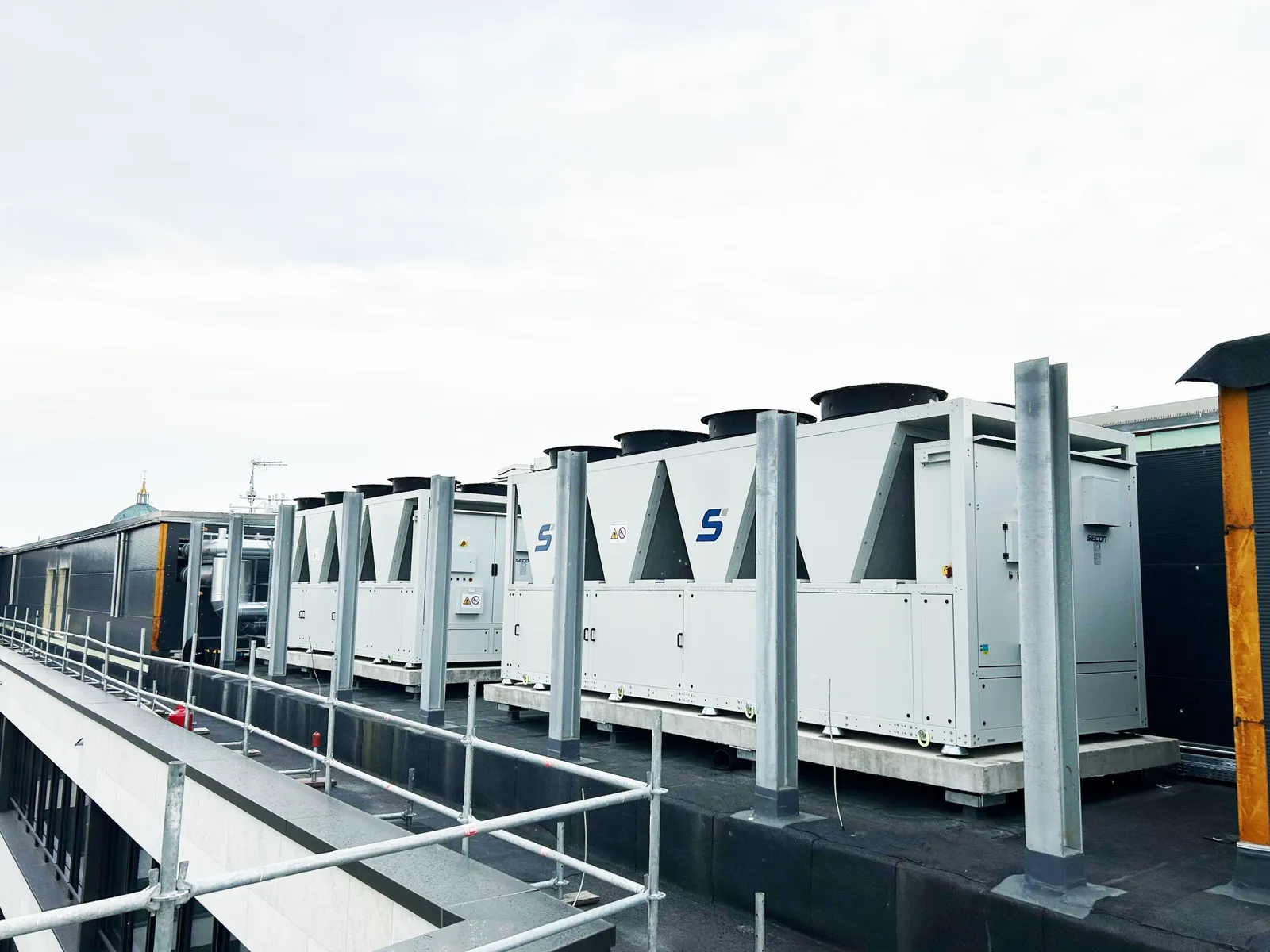
Key Technical Features
- System Type
- 2x STRATOS VP air-cooled chillersOne chiller is equipped with heat recovery
- Refrigerant
- PropaneTwo separate refrigerant circuits per chiller
- Charge
- 16kg per circuit21kg per circuit for the chiller with heat recovery
- Cooling Capacity
- 470kW (133TR) for each of the two chillers
- Temperature Level
- 15°C/9°C (59°F/48°F)
- Max Ambient Operating Temperature
- 35°C (95°F)
- Max Waste Heat Reuse Capacity
- 590kW (167TR)Realistic heat use in winter: 160kW (45.4TR)
- Heat Recovery Temperature
- 45°C/35°C (113°F/95°F)
- Efficiency
- EER of 4.74