
Chapters
- Introduction
- Technology and Market Overview
- The Policy, Regulatory and Standards Landscape
- Market Availability and Installation Data
Deep Dives

Company profile
TEKO manufactures CO₂ (R744) racks, chillers and heat pumps. The company was founded in 1982 and is headquartered in Altenstadt, Germany. TEKO is part of the KKVB Group, which also includes the Canadian CO₂ heat pump manufacturer Vitalis and the Austrian industrial CO₂ refrigeration system manufacturer Frigopol.
For this Deep Dive ATMOsphere spoke with Roman Weingart, Manager of the Heating and Cooling Business Unit at TEKO, about why demand for CO₂ chillers and heat pumps has grown in recent years along with the challenges that need to be addressed to unlock further growth.
Interview
Question 1 of 7
Can you briefly detail TEKO’s natural refrigerant chiller and heat pump lineup?
Roman Weingart
Our current lineup is marketed under the COOLSHIFT series and covers cooling capacities from approximately 50kW [14.2TR] up to 1.5MW [426TR] and heating capacities up to 3MW [853TR], depending on the configuration and application. These systems are designed for year‐round operation and can provide simultaneous cooling and heat recovery where required.
In Europe, 100% of TEKO’s newly sold chillers and heat pumps are based on natural refrigerants, primarily CO₂. This positioning is a deliberate strategic choice and not a transitional phase. CO₂ systems are not treated as an alternative but as the core technology across TEKO’s development roadmap. The same applies to TEKO’s broader refrigeration portfolio where the share of CO₂ systems has steadily increased over the past decade and now dominates new installations.
Question 2 of 7
What is currently driving demand for TEKO’s natural refrigerant chillers and heat pumps in Europe and why?
RW
Demand is primarily driven by food retail, logistics and cold storage, industrial process cooling and increasingly district energy and commercial building applications. End users typically require systems that deliver both high energy efficiency and long‐term regulatory security, particularly as European f‐gas restrictions continue to tighten. CO₂ technology allows these operators to combine cooling, heating and heat recovery within a single system architecture, which is especially attractive in applications with simultaneous thermal demands.
Over the past three to five years, demand for CO₂‐based chillers and heat pumps has grown significantly and consistently. Initially, adoption was largely compliance‐driven, particularly in food retail and industrial refrigeration. More recently, demand has broadened as customers increasingly recognize the economic and operational benefits of integrated cooling and heating solutions, including reduced energy costs and improved total cost of ownership. The rapid scale up of CO₂ installations across Europe, including megawatt‐scale industrial projects, underlines this shift from niche adoption to mainstream acceptance.
Question 3 of 7
What are the top drivers for the adoption of natural refrigerant commercial chillers and heat pumps in Europe?
RW
Regulation remains the primary initial driver, particularly the ongoing phase down of fluorinated gases under the EU F‐gas Regulation. However, regulation alone does not explain the current pace of adoption. Customers are increasingly prioritizing energy efficiency, waste heat utilization and long‐term investment security when selecting system technologies. CO₂ systems respond well to these requirements, especially in applications where heat recovery can be used for space heating, domestic hot water or industrial processes.
A second major driver is the growing alignment between corporate sustainability targets and system design decisions. Many European end users now translate ESG commitments into concrete technical specifications, favoring refrigerants with a GWP of 1 and transparent lifecycle performance. In this context, natural refrigerant chillers and heat pumps are no longer seen as experimental or “green premium” solutions but as robust, future‐proof infrastructure. This shift is clearly reflected in TEKO’s order intake and the expanding range of large‐scale CO₂ HVAC projects.
Question 4 of 7
What are some of the barriers preventing the wider adoption of commercial natural refrigerant chillers and heat pumps, and how can these be overcome?
RW
Despite strong momentum, several barriers still limit the wider adoption of natural refrigerant chillers and heat pumps. These include higher initial investment costs, a perceived complexity of CO₂ systems and in some regions a shortage of sufficiently trained planners and installers. In addition, legacy HVAC design standards and conservative procurement processes can slow down decision‐making, particularly in commercial building projects.
These barriers are largely structural rather than technological. Effective solutions already exist and are increasingly being implemented. Standardization and modular system concepts help reduce engineering effort and installation complexity, while serial production improves cost competitiveness at scale.
At the same time, targeted training programs and closer collaboration between manufacturers, system integrators and controls providers significantly lower the entry threshold for new customers. From TEKO’s perspective, practical experience consistently shows that once a CO₂ system is commissioned and operating, acceptance barriers diminish rapidly.
Question 5 of 7
One trend we’ve noticed is a growing demand for larger chillers/heat pumps from 500kW up to and exceeding 1MW. What is TEKO’s approach to meeting this demand: modularity or building larger individual units?
RW
TEKO primarily addresses the growing demand for large‐capacity systems through a modular architecture rather than by building single, oversized units. The COOLSHIFT L and XL platforms are designed to be combined into multi‐module systems, allowing capacities well beyond 1MW [284TR] while maintaining redundancy, transportability and serviceability. This approach also ensures high part‐load efficiency, which is critical for real‐world operating profiles in commercial and industrial applications.
Modularity further enables customized system layouts without sacrificing standardization. For customers, this translates into shorter delivery times, predictable performance and easier system expansion over the lifecycle of the installation. TEKO applies this principle consistently across both cooling‐dominant and heat‐recovery‐driven projects, including logistics centers and industrial sites.
Question 6 of 7
What trend or new development related to natural refrigerant chillers and heat pumps in Europe is TEKO watching closely?
RW
TEKO is closely monitoring the convergence of refrigeration, heating and district energy systems in Europe. CO₂ technology increasingly acts as a link between traditionally separate energy domains, enabling integrated solutions that combine cooling, heating and grid‐interactive operation. This trend is reinforced by rising energy costs and the political push toward sector coupling across the EU.
This development directly influences TEKO’s product strategy, with a clear emphasis on heat pump functionality, higher supply temperatures and intelligent control systems. Rather than developing isolated appliances, TEKO focuses on system platforms that can be adapted to multiple use cases.
Question 7 of 7
What do you see as the next industry in Europe to be disrupted by natural refrigerant commercial chillers and heat pumps and why?
RW
The next major disruption is likely to occur in commercial buildings that have traditionally relied on gas boilers or HFC‐based chillers, such as office buildings, mixed‐use developments and retail parks. As renovation cycles align with stricter climate targets, natural refrigerant heat pumps and chillers are increasingly positioned as drop‐in infrastructure replacements rather than niche alternatives.
This is particularly true where simultaneous heating and cooling demands exist. In this segment, CO₂ systems are expected to gain traction because they offer high efficiency, regulatory certainty and the ability to integrate with existing heat distribution systems. From TEKO’s point of view, the technological foundation is already in place: The remaining challenge lies in accelerating planning acceptance and market familiarity.
- The demand drivers for CO₂ chillers and heat pumps are shifting. While regulatory compliance is still the primary driver, end users are becoming increasingly interested in the economic and operational benefits of integrated CO₂-based heating and cooling systems.
- Modular architectures help reduce installation complexity, ensure high part-load efficiency and enable customized system layouts – all without sacrificing standardization in production.
- A combination of renovation cycles and stricter regulations makes offices and other large buildings the next major target for natural refrigerant-based chillers and heat pumps. Natural refrigerant systems are increasingly being positioned as the go-to drop-in replacements for HFC-based chillers and fossil boilers.
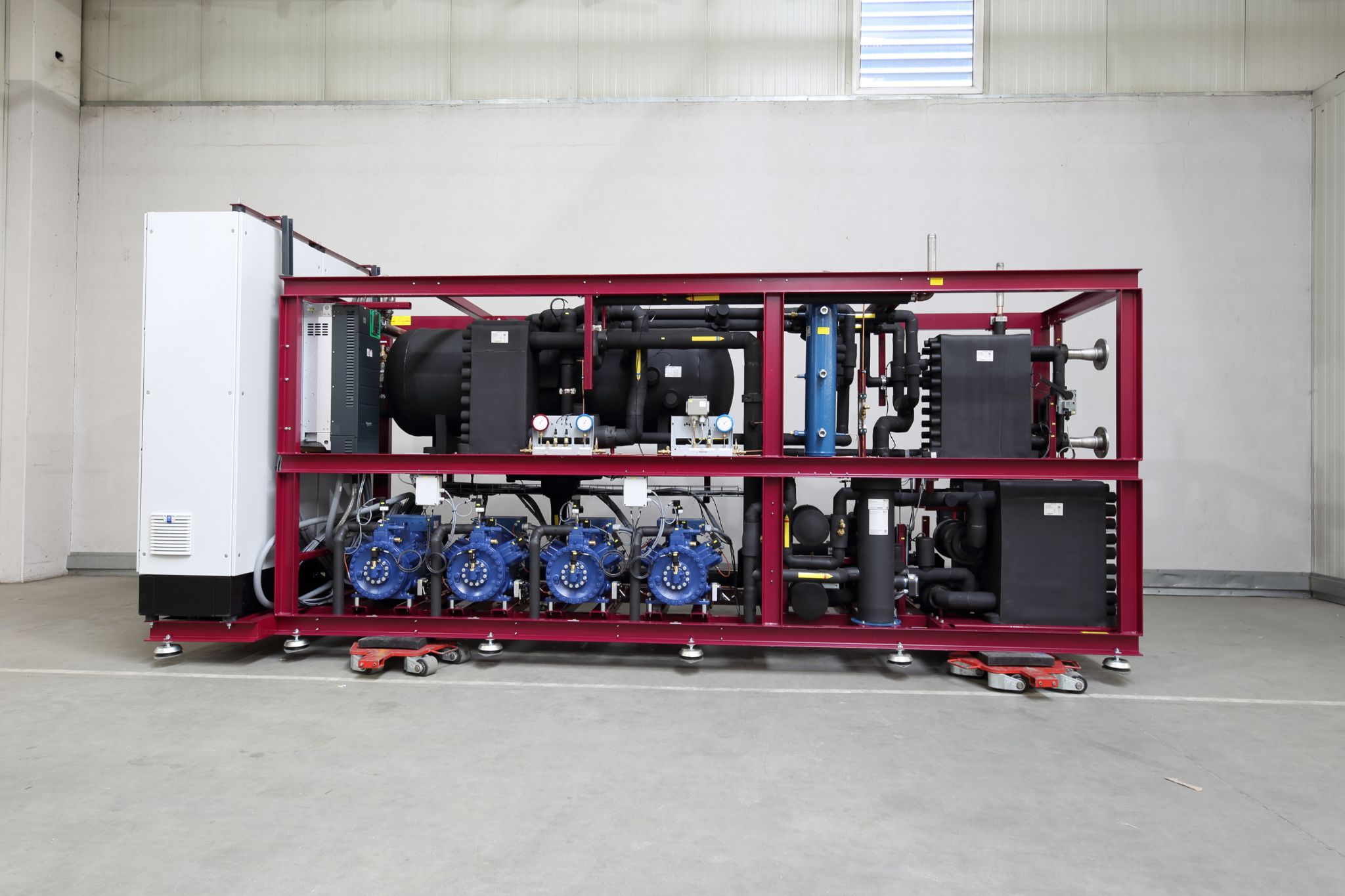
TEKO installed a CO₂-based chiller with integrated heat recovery for a wine producer in northern Italy. The system, engineered and manufactured by Frigopol, part of the TEKO Group, was commissioned in summer 2025 as part of the newly built production site. The objective was to provide reliable process cooling while simultaneously improving the overall energy efficiency of the facility by reusing waste heat.
The installation is based on a transcritical CO₂ system with low-lift ejector technology designed specifically for industrial process cooling applications. Cooling is provided via a brine circuit supplying the required temperature levels for the production processes. Semi-flooded evaporators are used to enhance heat transfer and ensure stable operation under varying load conditions.
At the core of the system are four six-cylinder compressors providing flexible and reliable capacity control. The lead compressor is equipped with a frequency inverter, allowing continuous capacity modulation according to cooling demand. The remaining compressors operate with step capacity control at 33/66/100%.
To further improve efficiency, two ejectors are integrated into the system, enhancing performance particularly under transcritical operating conditions. One integrated system delivers both process cooling and useful heat, significantly reducing total energy demand.
Energy Efficiency and Sustainability
A key feature of the installation is the integrated heat recovery system with a capacity of up to 200kW (56TR), enabling the production of hot water at temperatures of up to 70°C (158ºF). This recovered heat is used within the facility and reduces the demand for additional heating systems. By combining process cooling with heat recovery, the system maximizes the use of available energy and significantly improves the overall efficiency of the installation.
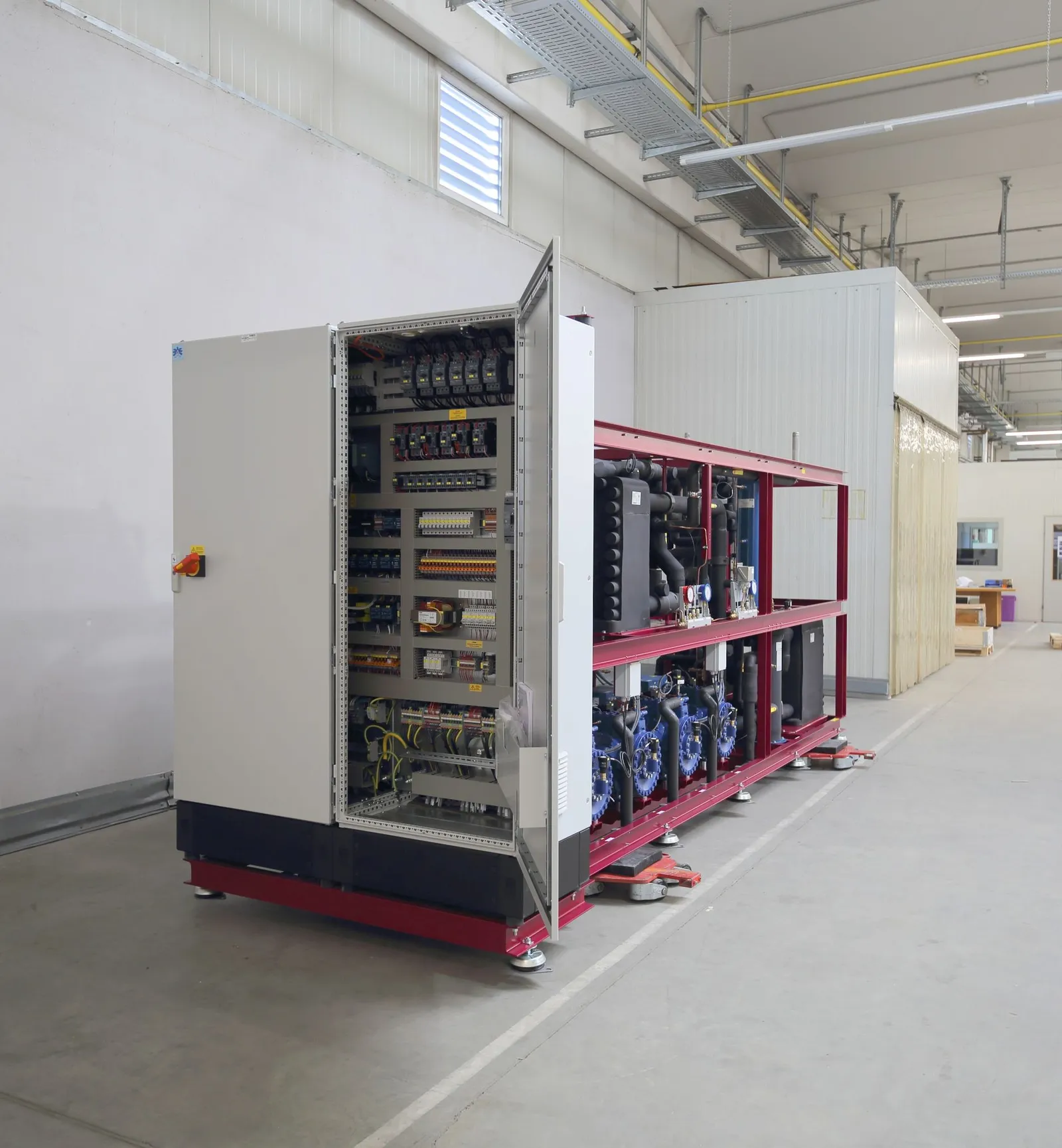
Key Technical Features
- System Type
- Transcritical CO₂ using low-lift ejector technology
- Cooling Capacity
- 350kW (99TR) at 5°C (41°F) return/−1°C (30°F) supply (brine)
- Heat Recovery Capacity
- Up to 200kW (56TR) for hot water production at 60–70°C (140–158°F)
- Design Ambient Temperature
- 38°C (100°F)
- Efficiency
- EER (at design conditions): 2.01Combined COP (cooling and heating): 3.46
- Capacity Control
- 4 Six-cylinder compressors Lead compressor with frequency inverterRemaining compressors with step capacity control (33/66/100%)
- Efficiency Features
- Two ejectors for improved efficiencySemi-flooded evaporators
- Control System
- Wurm hardwareTEKO software