
Chapters
- Introduction
- Technology and Market Overview
- The Policy, Regulatory and Standards Landscape
- Market Availability and Installation Data
Deep Dives

The Menerga CO₂mpass, an air-handling unit with an integrated CO₂ heat pump, on display at ISH 2025. Photo credit: Systemair
Company Profile: Systemair was founded in Sweden in 1974 and was originally a manufacturer of circular in-line centrifugal duct fans. Today it offers a wide range of HVAC equipment for both residential and commercial applications, including air-handling units (AHU), ventilation systems, heat pumps and fans.
Systemair acquired Menerga, a German manufacturer of AHUs, in 2013.1 For this Deep Dive, ATMOsphere spoke with Slobodan Rakulj, R&D Engineer at Systemair Slovenia, about Menerga’s newest AHU, which features an integrated CO₂ (R744) heat pump, and the opportunity for natural refrigerants in integrated HVAC systems.
Interview
Question 1 of 7
Can you briefly detail Systemair’s natural refrigerant chiller and heat pump lineup?
Slobodan Rakulj
Menerga is currently developing HVAC systems around natural refrigerants, and CO₂ is the main one in our latest heat pump. The CO₂mpass platform puts an air-handling unit and an integrated CO₂ heat pump into one system, built for heating, cooling, ventilation and, depending on the job, dehumidification and heat recovery.
It’s a good fit for swimming pools, wellness centers and other buildings that need heating and cooling at the same time. CO₂mpass isn’t one fixed heat pump: It’s a range covering different applications and capacities. A lot of the focus goes into making good use of the recovered heat at different temperature levels. In a pool application, for example, that recovered heat can go toward heating the air, the pool water and domestic hot water.
Question 2 of 7
What is currently driving demand for Systemair’s natural refrigerant chillers and heat pumps in Europe and why?
SR
Demand is coming mostly from applications that use a lot of energy and have a real need for heat recovery. Pools are the clearest example – they need constant ventilation and dehumidification, plus heating for the air, the pool water and domestic hot water, all at once. Beyond that we’re seeing demand from hotels, wellness facilities, hospitals, commercial buildings and industrial sites. Interest in natural refrigerants has grown noticeably over the last three to five years.
Higher energy costs, decarbonization targets and the tightening f-gas rules in Europe are all pushing that. The retrofit side is picking up too: A lot of existing plant rooms and HVAC systems across Europe are getting old enough to need modernizing, and swapping older HFC equipment for a natural refrigerant system solves both the regulatory issue and the efficiency issue simultaneously.
Question 3 of 7
What are the top drivers for the adoption of natural refrigerant commercial chillers and heat pumps in Europe?
SR
Regulation and efficiency are the two biggest ones right now. The f-gas rules are steadily cutting down what high-GWP refrigerants can be used for, so refrigerant choice is something you have to think about early at the design stage, not after.
Efficiency matters just as much. CO₂ works especially well where there’s a demand for cooling and high-temperature heat at the same time. The transcritical CO₂ process can pull heat out at different temperature levels and, depending on the application, get water up to around 70°C [158°F]. On top of that, sustainability targets, running costs and how long the equipment needs to last are all pushing building owners to look harder at natural refrigerants.
Question 4 of 7
What are some of the barriers preventing the wider adoption of commercial natural refrigerant chillers and heat pumps, and how can these be overcome?
SR
The big one is pressure – CO₂ systems run at much higher pressure than conventional HFC systems, which raises the bar on component selection, design, installation and commissioning. There’s also a knowledge gap since a lot of designers and installers built their experience around conventional refrigerants over many years.
The fix is mostly technical education and hands-on experience. You can’t just treat CO₂ as a drop-in replacement for an HFC. It has to be designed around it from the start. At Menerga we’re closing that gap through our own product development, testing and commissioning work. Using our own production site to install the CO₂mpass 35.20 lets us get real operating experience and feed it straight back into product development.
Question 5 of 7
One trend we’ve noticed is a growing demand for larger chillers/heat pumps from 500kW up to and exceeding 1MW. What is Systemair’s approach to meeting this demand: modularity or building larger individual units?
SR
We treat both as relevant options. Which one makes sense depends on the application: available space, redundancy needs and how the heat pump has to tie into the rest of the HVAC system. We’re not just chasing bigger nominal capacity on a single unit. The real focus is a scalable system concept that can flex to what the project needs. For Menerga, that means integrating with the air-handling system so the whole thing works as one energy system rather than treating the chiller or heat pump as something standalone bolted on.
Question 6 of 7
What trend or new development related to natural refrigerant chillers and heat pumps in Europe is Systemair watching closely?
SR
Two things we’re keeping a close eye on are refrigerant regulations continuing to tighten and the growth of the European retrofit market. The two are tied together. A lot of existing HVAC installations were built around refrigerants and technology that are getting harder to justify keeping over the equipment’s lifetime.
That’s creating demand for solutions that hold up not just today but years down the line from a refrigerant standpoint. Our development work is built around natural refrigerants, better system efficiency and flexible integration into existing HVAC setups. Retrofit capability is only going to matter more since Europe has a huge base of existing systems that will need modernizing in the coming years.
Question 7 of 7
What do you see as the next industry in Europe to be disrupted by natural refrigerant commercial chillers and heat pumps and why?
SR
We think natural refrigerants will hit hardest in integrated HVAC systems – cases where heating, cooling and ventilation are currently handled by separate equipment. Pools already show what’s possible since they need cooling/dehumidification and heating at the same time.
The next step is treating the heat pump as part of one integrated energy system where heat pulled out of one process gets recovered and reused elsewhere instead of just being thrown away. That can cut both energy use and the number of separate systems a building needs. We see a lot of room for this in hotels, wellness facilities, hospitals, industrial buildings and retrofit projects.
Key Takeaways
- Applications where there’s a demand for simultaneous cooling and high-temperature heat – such as pools, hotels and hospitals – are driving demand for integrated CO₂-based HVAC solutions.
- The technical hurdles associated with CO₂ heat pumps, specifically the high operating pressures, can be addressed through technical education and hands-on experience.
- There is an opening for natural refrigerants in the commercial HVAC sector, specifically in applications where heating, cooling and ventilation are currently handled by separate equipment.
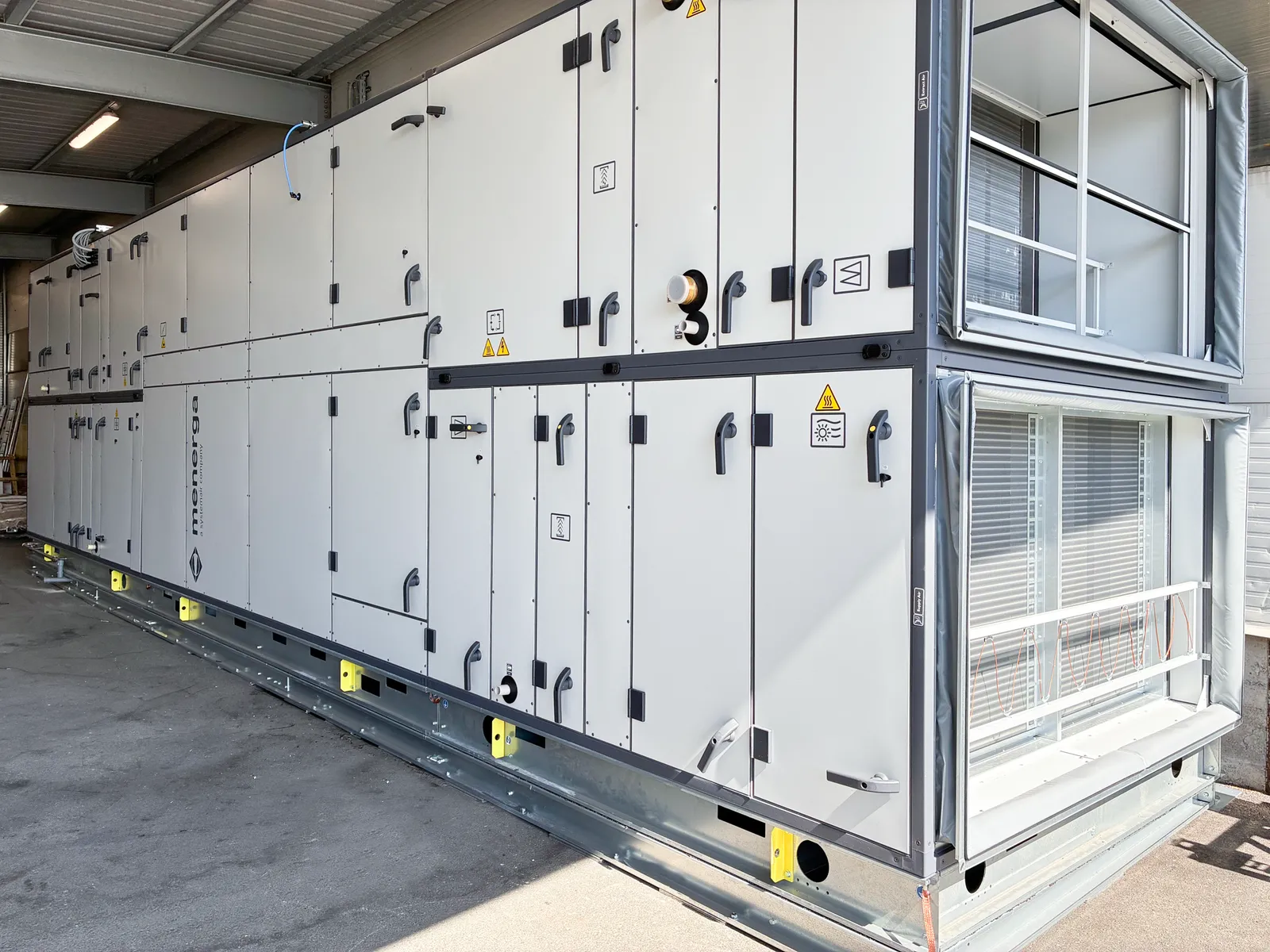
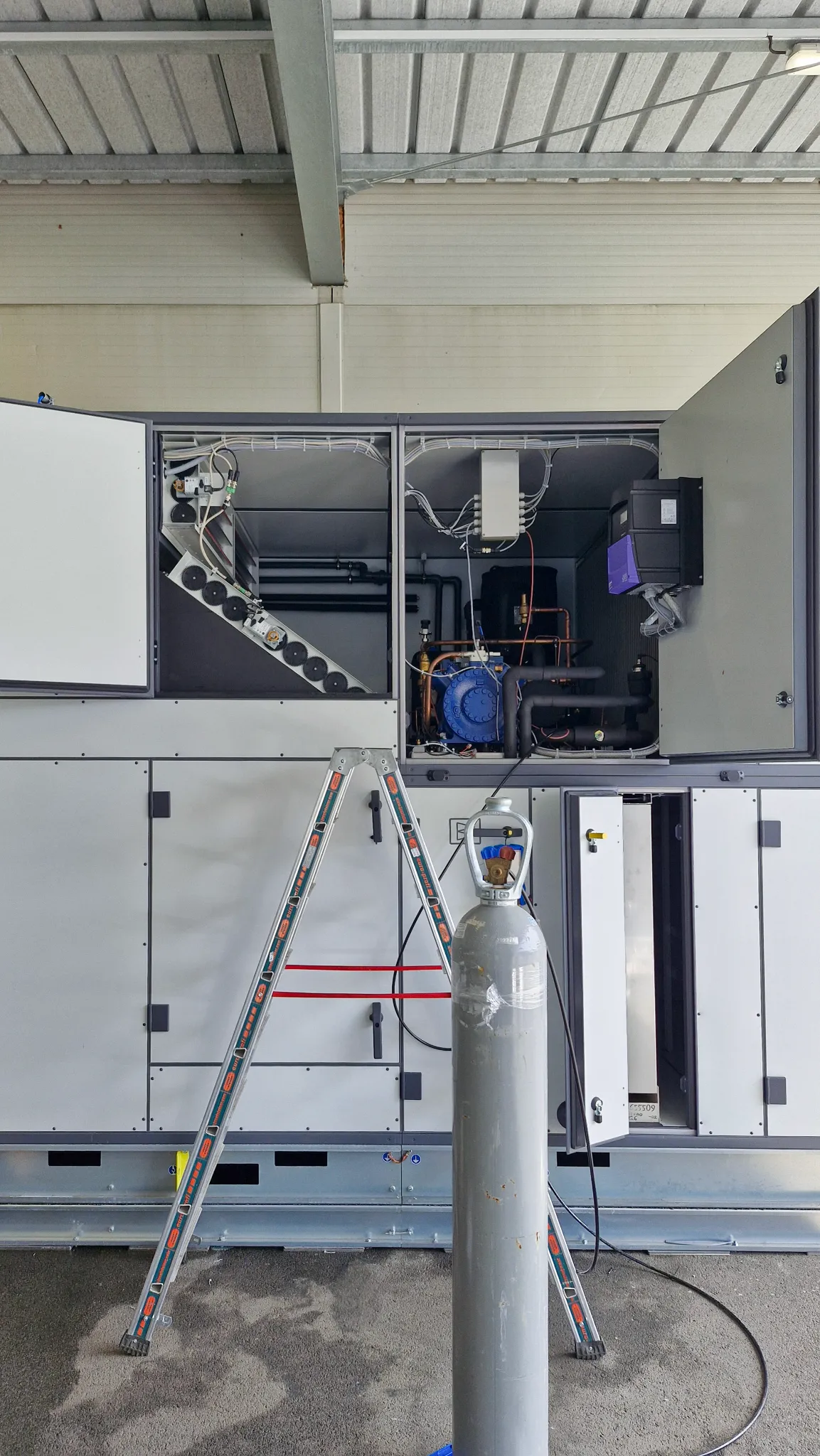
Menerga is currently commissioning two CO₂mpass 35.20 air-handling units at its production facility in Maribor, Slovenia. Each unit features an integrated CO₂ heat pump, and together the pair will handle ventilation, heating and cooling for the facility, which has 4,000m2 (43,000ft2) of production space and ceilings that reach 12m (39ft).
Each CO₂mpass 35.20 moves 25,000 m3/h. The high load cooling capacity is 87.43kW (24.86TR) at design conditions of 35°C (95°F) ambient and 40% relative humidity. Adiabatic cooling brings the air temperature down to 20.2°C (68.3°F), and it exits the evaporator at 16.3°C (61.3°F). The EER (energy efficiency ratio) at high load is 5.2.
The low load cooling capacity is 43.86kW (12.47TR) at design conditions of 35°C (95°F) ambient and 40% relative humidity. Adiabatic cooling brings the air down to 22.7°C (72.8°F), and it exits the evaporator at 20.1°C (68.1°F). The EER is 6.9. Heating capacity is 32.39kW (9.20TR) with a COP of 3.0.
Drawing a Comparison
Before installing the CO₂mpass 35.20 units at Maribor, Menerga assessed the project’s operational requirements and identified the CO₂mpass as the most suitable solution. Unique in the market, the unit delivers strong energy performance across different operating conditions, achieving an EER of 5.2 at high cooling load and 6.9 at low cooling load. This corresponds to electrical inputs of approximately 16.8kW and 6.4kW, respectively.
These numbers were modeled, and the real annual energy savings will depend on the production area’s operating profile as well as the cooling load, outdoor conditions and running hours. The comparable system also used a digital-scroll compressor as opposed to a variable-frequency drive.
Learning by Doing
In addition to energy efficiency, Menerga chose to install its own product to gather real-world performance data. The company’s engineering, development, product management and production teams were all involved in the development and implementation of the project. This creates a feedback loop designed to enable the development team to evaluate the performance of the CO₂mpass in a real industrial environment. The system’s energy consumption, part-load performance, compressor control and general operating behavior will all be checked against the original design assumptions, with the results used to optimize future systems.
While the Maribor project isn’t a retrofit, Menerga sees a lot of potential for the CO₂mpass in that market. This is because there is a large base of old HVAC systems that will need replacement, and energy efficiency requirements and refrigerant regulations are creating an opportunity for natural refrigerants. In this way the Maribor project is one of the last steps before the wider roll out of the CO₂mpass across Europe.
Key Technical Features
- System Type
- 2x Menerga CO₂mpass 35.20 units
- Refrigerant and Charge
- CO₂, 33kg per unit
- Airflow Volume
- 25,000 m3/h per unit
- Cooling Capacity
- High load: 87.43kW at 35°C ambient and 40% relative humidityLow load: 43.86kW at 35°C ambient and 40% relative humidity
- Cooling EER
- High load: 5.2Low load: 6.9
- Heating Capacity
- 32.39kW
- Heating COP
- 3.0
- Compressor Type
- Bock HGX34/170-4 SH CO₂T, 097G0085 Variable-frequency drive
Notes
- Systemair, March 28, 2013, “Systemair Acquires Menerga in Germany,” https://group.systemair.com/news/press-releases/2013/systemair-acquires-menerga-gmbh-in-germany/↩