
Chapters
- Introduction
- Technology and Market Overview
- The Policy, Regulatory and Standards Landscape
- Market Availability and Installation Data
Deep Dives

Company profile
SCM Frigo is an Italian manufacturer of commercial and industrial refrigeration systems and is a subsidiary of Beijer Ref. In 2024 the company announced the launch of a range of CO₂ (R744) heat pumps developed in partnership with Danish heat pump and chiller manufacturer Fenagy.
SCM Frigo’s Manfred Mahnert, International Business Development Director, and Mirko Bernabei, Beijer Ref OEM Segment Technical Director, spoke about the development of the SMART Heat Pump and their outlook on the commercial HVAC sector.
Interview
Question 1 of 7
Why did SCM Frigo decide to develop a CO₂ heat pump, and why did it partner with Fenagy?
Manfred Mahnert
SCM Frigo’s decision to develop a heat pump grew directly out of decades of experience in CO₂ refrigeration, heat recovery and false-load management for commercial and industrial applications. As that expertise matured, moving into heat pump technology was a natural next step: CO₂’s ability to operate with a high delta-T and deliver high supply temperatures made it particularly well suited to heating applications, and we recognized an opportunity to apply our existing know-how to a new product category.
For the intelligence and software side of the project, we partnered with Fenagy because of their specific experience with CO₂ direct expansion heat pumps. Their strengths in software and control logic complemented our own in mechanical and refrigeration engineering.
Question 2 of 7
What role did SCM Frigo’s background in refrigeration play in the development of this heat pump?
Mirko Bernabei
Developing the SMART Heat Pump required considerably more than adapting existing refrigeration equipment. It meant rethinking core functionalities from the ground up rather than simply relabelling a booster system as a heat pump.
In particular, the hydraulic design and water-side engineering demanded close attention, and this is a fundamentally different discipline from traditional refrigeration work. Our CO₂ experience gave us the technical grounding and the confidence to take on the project, but building a genuine heat pump application meant developing new expertise and treating it as its own distinct engineering challenge, not an extension of an existing one.
Question 3 of 7
The SMART Heat Pump is available in air-to-water and water-to-water models. Why did SCM Frigo decide to offer both?
MM
Our initial plan was to focus mainly on air-to-water units. As the project progressed, however, both our own market study and the demand we were seeing pointed clearly to a real need for water-to-water heat pumps as well, so we made the decision to develop both configurations in parallel.
At the outset we expected the split to land around 70% air-to-water and 30% water-to-water. Based on the requests we’re receiving, that balance has shifted, and we currently expect something closer to a 50/50 split between the two. Offering both configurations lets us cover a much wider range of building types and applications across Europe than either model could address on its own.
Question 4 of 7
Where is the SMART Heat Pump currently at in its development timeline, and where is demand coming from?
MM
The SMART Heat Pump is currently in serial status and approaching go-to-market, which we expect to complete at the beginning of next year. We already have a solid base of units operating in the field, with our first installation dating back to 2024, giving us real-world operating experience to draw on as we finalize the product ahead of a full commercial launch.
Demand is coming from a broad range of sectors. Multifamily residential buildings and offices form a strong core market, alongside process and industrial applications, including pharmaceutical facilities. Because our water-to-water units can be paired with buffer tanks, they are particularly well-suited to combined air-conditioning and heating needs, and we also see potential in smaller district heating systems. The SMART Heat Pump covers the complete 30–300kW [8.5–85TR] range, and a master–slave configuration allows several units to be linked together on a single project for larger capacity requirements.
Question 5 of 7
What applications does SCM Frigo see CO₂ heat pumps being a better fit for compared to other natural refrigerants and why?
MB
CO₂’s key advantage over other natural refrigerants is its ability to operate efficiently across a much wider temperature difference. Hydrocarbon and ammonia [R717] systems generally need to work within a comparatively narrow temperature spread, whereas CO₂ heat pumps handle high delta-T applications extremely well. This makes them best in class for producing hot service or tap water, heating from around 10°C up to 65°C [50°F up to 149°F] in a single pass.
Ammonia systems also tend to be reserved for larger-scale applications, whereas our SMART Heat Pump range starts at 30kW, making it a strong fit across a much broader span of project sizes, including smaller and mid-sized commercial installations. On top of that, CO₂ service technicians are considerably more widely available across Europe than ammonia specialists, a practical advantage for installation, servicing and long-term maintenance support.
Question 6 of 7
What challenges or barriers are there to the widespread adoption of commercial CO₂ heat pumps in Europe, and how can these be overcome?
MM
The biggest barrier is a general lack of understanding of how the technology actually works, in particular its ability to operate across a much wider temperature spread than conventional heat pumps. Standard heat pumps are typically designed around a 5–10K temperature difference, while CO₂ heat pumps can comfortably handle 20 to 50K. That difference requires the HVAC industry to rethink some long-standing design assumptions.
Heat pump technology in general is still not that well known across much of Europe, and layering CO₂-specific technology on top adds a further degree of complexity for installers, specifiers and end users alike. We believe the way to overcome this is through targeted training, closer information-sharing across the industry and continued education to build familiarity and confidence with CO₂ heat pumps.
It’s worth noting that the SMART Heat Pump’s high delta-T capability also makes it a strong direct replacement for gas or oil boilers in buildings with lower return temperatures – such as those built after 1995 – which is exactly the kind of practical advantage that becomes clear once the technology is better understood.
Question 7 of 7
What do you see as the next industry in Europe to be disrupted by natural refrigerant commercial chillers and heat pumps and why?
MB
Rather than pointing to one specific sector, we see natural refrigerant heat pumps having the potential to disrupt commercial HVAC broadly, because the SMART Heat Pump can be adapted to nearly any system where hot water is needed. Whether that means replacing an aging gas boiler or a conventional water-to-water chiller, natural refrigerant heat pumps are increasingly able to step into applications that have historically relied on other technologies.
Looking ahead, we are already developing the next generation of the SMART Heat Pump. We’re targeting even higher performance and COP, and it’s being designed to run at higher ambient temperatures as well as higher inlet and outlet water temperatures. It’s this continued push to expand the operating envelope of CO₂ heat pump technology that we expect to keep unlocking new applications and drive disruption across an increasingly broad section of the commercial HVAC sector rather than any single niche.
- Building a CO₂ refrigeration system is not the same as building a CO₂ heat pump. Hydraulic design, water-side engineering, software and control logic are all areas of expertise that need to be developed – or acquired via partnership with an established heat pump manufacturer.
- There is a growing demand for commercial water-to-water heat pumps, with SCM Frigo seeing a 50/50 split in demand with air-to-water systems.
- There is still a knowledge gap regarding heat pump technology, and adding CO₂ to the mix can further complicate matters. This makes targeted training from manufacturers essential to the growth of commercial CO₂ heat pumps in Europe.

SCM Frigo supplied two water-to-water SMART Heat Pumps (SHP) to TTC Norge, a Norwegian heat exchanger manufacturer and fellow subsidiary of Beijer Ref, to provide space heating and comfort cooling for its factory in Slitu. Each unit has a heating capacity of 175kW (49.7TR), a cooling capacity of 111kW (31.5TR) and operates as a self-contained refrigeration circuit. With the necessary valves, pumps and controls in place, further SHPs can be integrated.
The SHPs replaced an existing heat generator using fossil fuels. The two units were commissioned in June 2025, marking one of the earliest installations of SCM Frigo’s SMART Heat Pump. Although Norway sits outside the EU, it applies equivalent rules to the EU F-gas Regulation through the European Economic Area agreement and has its own long-standing national tax on HFC refrigerants. This is among the strongest in Europe, which further incentivizes natural refrigerant solutions like CO₂ heat pumps.
Under the Hood
The SHPs heat and cool a water/brine circuit on the secondary side, with the design point set at 65°C flow/40°C return (149°F/104°F) in winter and at an evaporation temperature of 5°C (41°F) in summer time. Each unit uses two Bitzer semi-hermetic reciprocating compressors (4FTEU-30K), one of which is speed-controlled via inverter, while Reftronix provided the embedded controls platform. Plate heat exchangers from Alfa Laval, SWEP and Kelvion serve the gas cooler, evaporator and internal heat exchanger. Safety-critical components include pressure switches from Emerson, an oil separator from Klimal and safety valves from Castel.
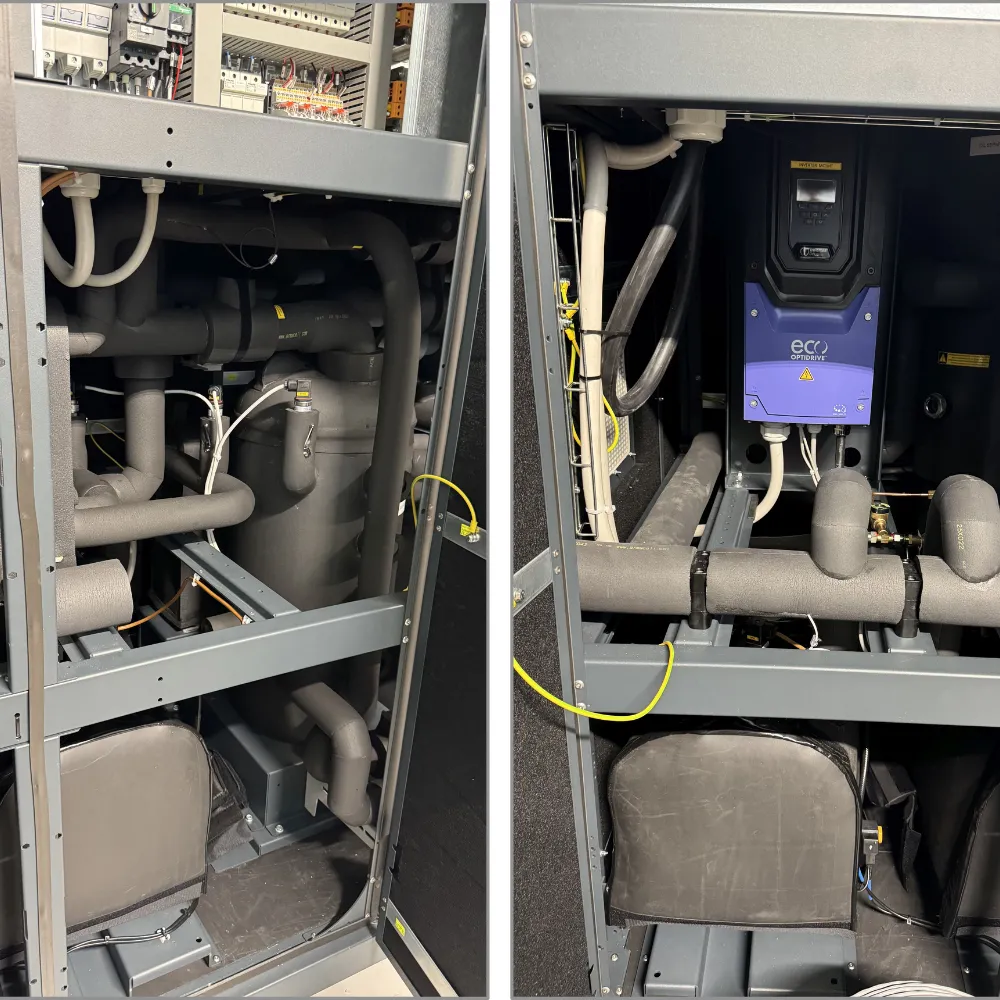
Efficiency is enhanced by two low-pressure ejectors per unit working in parallel to recover expansion energy that would otherwise be lost; because they share a single check valve on the common ejector suction line, the two ejectors always operate together rather than in sequence. At the winter design condition point, the SHP units are rated for a heating COP of approximately 3.1 calculated at an evaporation temperature of −9°C (15°F). The units are currently running without the ejector engaged, so this figure doesn’t yet reflect the efficiency gain the ejector technology is designed to deliver.
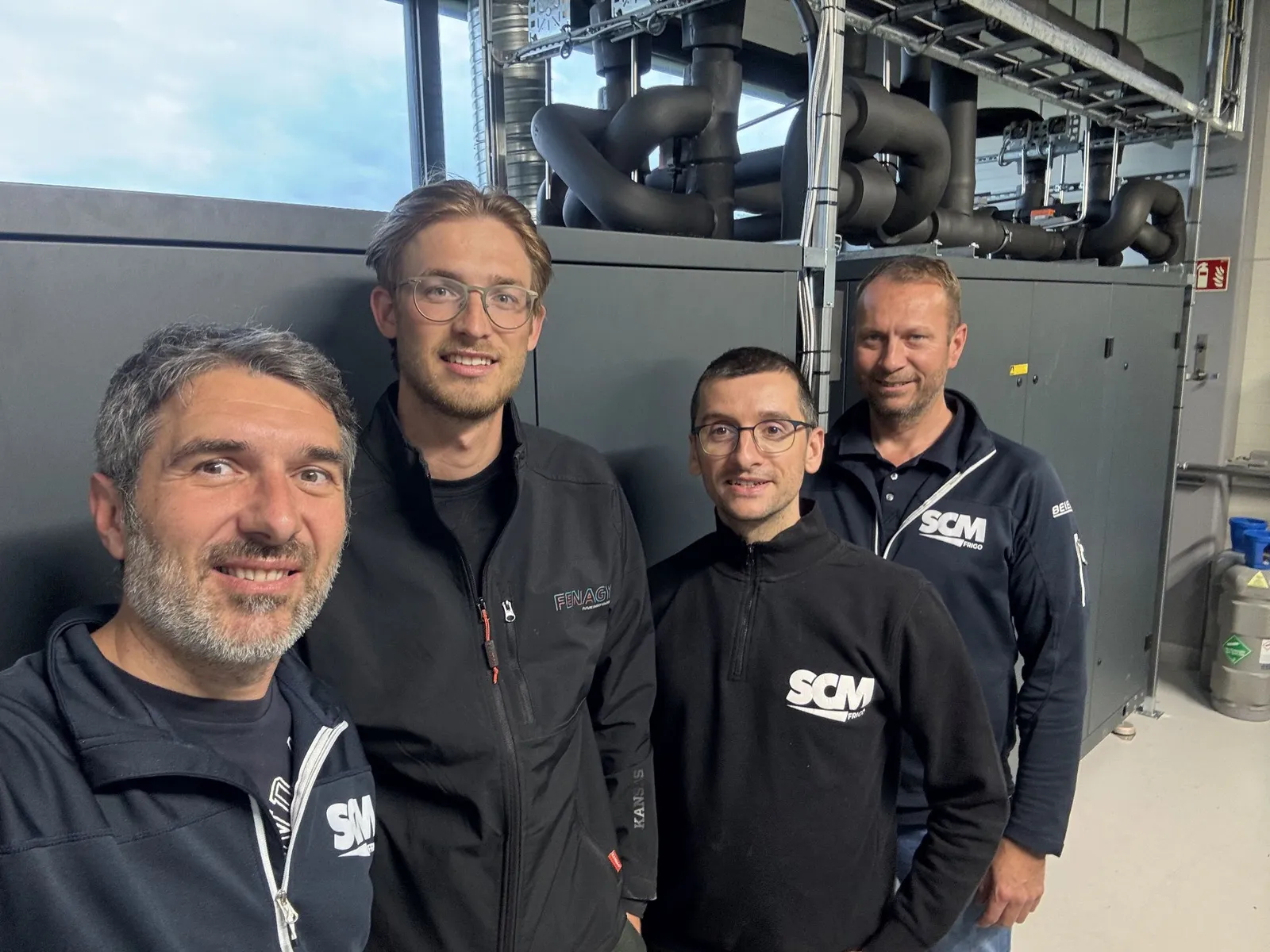
Beyond individual component suppliers, the project reflects SCM Frigo’s tripartite partnership model: Fenagy contributes the intelligence and software layer of the SMART Heat Pump while Beijer Ref acts as commercial integrator, connecting the technology to end customers such as TTC Norge across the Nordic market.
Lessons Learned, Looking Ahead
This project came with the challenges of bringing a new heat pump platform from prototype to first implementation. One lesson learned: The units were designed with two operating modes, with and without the low-pressure ejector engaged, and switching between them requires an on-site adjustment to settings and valve positions rather than a remote change. In future projects, SCM Frigo is looking at ways to make that kind of reconfiguration simpler for field teams.
The project also underscored the importance of clearly defining hydraulic and controls scope between SCM Frigo and the customer. The units are configured as slave units, with the customer’s team managing the water side. That division of responsibility is a useful reference point for how we structure similar projects going forward.
Looking ahead, SCM Frigo’s priority is to bring the SMART Heat Pump to full commercial launch and scale it across the European market, building on its experience in the field in Norway and elsewhere. On the product roadmap, it’s working on a 10-year plan to keep pushing performance and COP higher, including support for higher return temperatures and a reversible cycle that would let the same unit switch between air-to-water and air-to-air operation. It’s also developing a split version of the air-to-water configuration, with the evaporator located outside and the compressors housed indoors, to widen the range of installation types the SMART Heat Pump can serve.
Key Technical Features
- Refrigerant Type
- CO₂, transcritical
- Cooling Capacity
- Approximately 111kW (31.5TR) per unit at a design calculation evaporation temperature of −9°C (15°F)
- Heating Capacity
- 175kW (49.7TR) per unit at a design calculation evaporation temperature of 5°C, W40°C–65°C quotation value (41°F, W104°F–149°F)*An alternative calculation shows 157.6kW (44.8TR) per unit at a design calculation evaporation temperature of −9°C, with a heating COP of 3.1
- Compressors
- 2 × Bitzer 4FTEU-30K per unit, first compressor with variable frequency drive (inverter)
- Capacity Control
- Stepless control via inverter on the lead compressor plus multi-stage control via the second compressor
- Efficiency Features/Components
- Low-pressure ejector technology, plate heat exchangers for gas cooler and evaporator
- Controls
- Embedded Reftronix controller